
Katakalon
(Olympia), Greece
Continuing our 12 Night Mediterranean and Greek Isles Cruise we journey to ancient Greece once more. This time we find ourselves in the ancient Olympia Archaeological Site, the birthplace of the Olympic games which
started on these very grounds in 776 B.C.
The games were held every Olympiad (i.e. every four years), a tradition that remains in modern times. The games were so important
to the Greeks that they put aside their traditional differences, and even
went as far as ceasing open hostilities in war time in order to descent
to the sanctuary of Olympia to compete in the honorable games.
During our guided tour of Olympia, we stood on the site of the current Olympic Stadium. The Olympic flame of the modern-day Olympic Games is lit by reflection of sunlight in a parabolic mirror in front of the Temple of Hera and then transported by a torch to the place where the games are held. Before we tell you more about the stadium, let's explore the other important ancient ruins.
Ancient Archaeological Site
The sanctuary, known as the Altis, consists of an unordered arrangement of various buildings. The sanctuary spreads around the green wooded feet of the Kronion hill at the confluence of the Alfeiós and Kládeos rivers.
The valley amongst the two rivers was in ancient times full of wild olive trees, poplars, oaks, pines and plane trees and it was these trees that gave the center of the sanctuary the name Altis, the sacred grove (from alsos, meaning grove).
The temples and religious buildings were located inside the Altis, the sanctuary to the gods. The sports structures designed for the events of the Olympic Games honoring Zeus as well as dwellings for the priests, baths, guest houses, etc. were outside of the Altis.
Gymnasion (The Gymnasium)
 The gymnasium in ancient Greece functioned as a training facility for competitors in public games. It was also a place for socializing and
engaging in intellectual pursuits. The name comes from the Ancient Greek
term gymnós meaning "naked". Athletes competed in the nude, a practice
said to encourage aesthetic appreciation of the male body and a tribute
to the gods.
The gymnasium in ancient Greece functioned as a training facility for competitors in public games. It was also a place for socializing and
engaging in intellectual pursuits. The name comes from the Ancient Greek
term gymnós meaning "naked". Athletes competed in the nude, a practice
said to encourage aesthetic appreciation of the male body and a tribute
to the gods.
 The ancient Greek gymnasium soon became
a place for more than exercise. The Greeks discovered the strong relation between athletics,
education and health. Accordingly, the gymnasium became connected with
education on the one hand and medicine on the other. Physical training
and maintenance of health and strength were the chief parts of
children's earlier education.
The ancient Greek gymnasium soon became
a place for more than exercise. The Greeks discovered the strong relation between athletics,
education and health. Accordingly, the gymnasium became connected with
education on the one hand and medicine on the other. Physical training
and maintenance of health and strength were the chief parts of
children's earlier education.
The Palaestra at Olympia is part of the gymnasium at the sanctuary. This sixty-six meter square building dates to the end of the third or beginning of the 2nd century BC. It was used to practice boxing, wrestling and jumping.
At its centre was an open court, forty one metres square, surrounded by a Doric colonnade of 72 columns and laid with fine sand on which the athletes trained.
Workshop of Pheidias

West of the sacred enclosure, directly opposite the temple of Zeus, was the Workshop of Pheidias where the great sculptor crafted the gigantic statue of Zeus, listed as one of the Seven Wonders of the ancient world.
The building was erected in the second half of the fifth century, when Pheidias, after completing the sculptures for the Athenian Acropolis, went to Olympia to work on the statue of Zeus. Excavation finds and pottery date it precisely to 430-420 BC.
Sometime between AD 435-451, an early Christian basilica was erected over the ruined foundation of the building. It had two colonnades, which divided the interior into three naves, and an apsidal sanctuary at the east end. One still can see the low marble chancel screen. The basilica was destroyed by the earthquake of AD 551.
 Temple of Zeus at Olympia
The massive Temple of Zeus, the most important building in the Altis, standing in its very centre, is the largest temple in the Peloponnese.
The Altis, the enclosure with its sacred grove, open-air altars and the tumulus of Pelops, was first formed during the tenth and ninth centuries BCE.
Although just a chaotic heap of ruins today, the dimensions of the temple are truly impressive. Only a bit smaller than the Parthenon in Athens, it was a classic temple in the Doric style, first built in the 5th century B.C.
The temple enshrined a gold and ivory statue, later removed to Constantinople by Theodosius II (where it was destroyed by fire in 475 BC). The statue, considered one of the Seven Wonders of the World, was crafted by the great sculptor Pheidias. The original was 44 feet high and lavishly decorated with Zeus on a throne of ivory and gold, holding a statue of Nike in his right hand, and a scepter with an eagle in his left.
One column has been restored and re-erected, and helps you put into perspective the temple's sheer size.
 Temple of Hera
Temple of Hera is an ancient Doric Greek temple at Olympia, Greece. The Temple of Hera was destroyed by an earthquake in the early 4th century AD, and never rebuilt. In modern times, the temple is the location where the torch of the Olympic flame is lit, by focusing the rays of the sun.
 Nymphaion
A Nymphaeum or Nymphaion in ancient Greece and Rome, was a monument consecrated to the nymphs, especially those of springs.
These monuments were originally natural grottoes, which tradition assigned as habitations to the local nymphs. They were sometimes so arranged as to furnish a supply of water, as at Pamphylian Side. A nymphaeum dedicated to a local water nymph, Coventina, was built along Hadrian's Wall, in the northernmost reach of the Roman Empire. Subsequently, artificial grottoes took the place of natural ones.
Olympic Stadium
 The Crypt, a vaulted passageway linking the stadium with the Altis, was built at the end of the 3rd century BCE.
The stadium, where the athletic games were held, was 212.54m long and 28.50m wide. The existing stadium was the third laid out at Olympia. The stadium had no seats, apart from the stone exedra of the Hellanodikai. The embankment could easily seat 45,000 spectators.
Crossing the finish line at the Olympic Stadium might not be in your future during an Olympic Game, but you can join me and imagine the thrill of victory and the cheers of the nations' athletes on this hallowed ground.
Our tour of Olympia isn't complete, but we will leave the rest of the visit to you as a homework assignment. All these pictures, and many more, are posted on our Facebook Fan Page in the album Ancient Olympia Archeological Site.

Additional photos can be found on our Facebook Albums.
Click on the image to the left for more Blog posts about this trip.


Sign-up for Exclusive Email Offers
Where have you explored?
Gather your travel and food pics and join us every Wednesday night for the latest installment of #FoodTravelChat
During our guided tour of Olympia, we stood on the site of the current Olympic Stadium. The Olympic flame of the modern-day Olympic Games is lit by reflection of sunlight in a parabolic mirror in front of the Temple of Hera and then transported by a torch to the place where the games are held. Before we tell you more about the stadium, let's explore the other important ancient ruins.
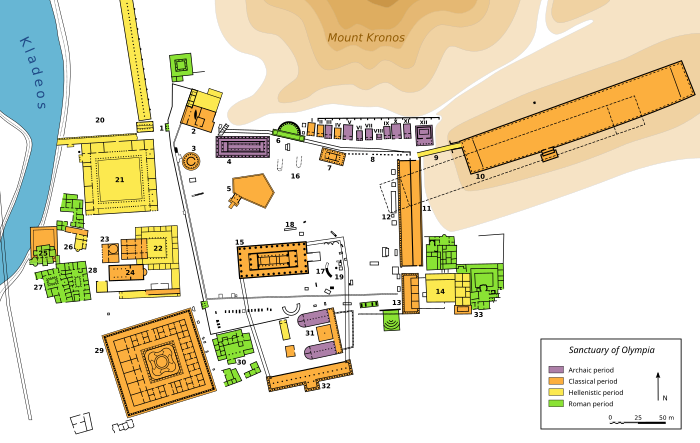 |
| Olympia Site Plan (click here for interactive version) |
The sanctuary, known as the Altis, consists of an unordered arrangement of various buildings. The sanctuary spreads around the green wooded feet of the Kronion hill at the confluence of the Alfeiós and Kládeos rivers.
The valley amongst the two rivers was in ancient times full of wild olive trees, poplars, oaks, pines and plane trees and it was these trees that gave the center of the sanctuary the name Altis, the sacred grove (from alsos, meaning grove).
The temples and religious buildings were located inside the Altis, the sanctuary to the gods. The sports structures designed for the events of the Olympic Games honoring Zeus as well as dwellings for the priests, baths, guest houses, etc. were outside of the Altis.
Gymnasion (The Gymnasium)

 The ancient Greek gymnasium soon became
a place for more than exercise. The Greeks discovered the strong relation between athletics,
education and health. Accordingly, the gymnasium became connected with
education on the one hand and medicine on the other. Physical training
and maintenance of health and strength were the chief parts of
children's earlier education.
The ancient Greek gymnasium soon became
a place for more than exercise. The Greeks discovered the strong relation between athletics,
education and health. Accordingly, the gymnasium became connected with
education on the one hand and medicine on the other. Physical training
and maintenance of health and strength were the chief parts of
children's earlier education.The Palaestra at Olympia is part of the gymnasium at the sanctuary. This sixty-six meter square building dates to the end of the third or beginning of the 2nd century BC. It was used to practice boxing, wrestling and jumping.
At its centre was an open court, forty one metres square, surrounded by a Doric colonnade of 72 columns and laid with fine sand on which the athletes trained.
Workshop of Pheidias

West of the sacred enclosure, directly opposite the temple of Zeus, was the Workshop of Pheidias where the great sculptor crafted the gigantic statue of Zeus, listed as one of the Seven Wonders of the ancient world.
The building was erected in the second half of the fifth century, when Pheidias, after completing the sculptures for the Athenian Acropolis, went to Olympia to work on the statue of Zeus. Excavation finds and pottery date it precisely to 430-420 BC.
Sometime between AD 435-451, an early Christian basilica was erected over the ruined foundation of the building. It had two colonnades, which divided the interior into three naves, and an apsidal sanctuary at the east end. One still can see the low marble chancel screen. The basilica was destroyed by the earthquake of AD 551.

The massive Temple of Zeus, the most important building in the Altis, standing in its very centre, is the largest temple in the Peloponnese.
The Altis, the enclosure with its sacred grove, open-air altars and the tumulus of Pelops, was first formed during the tenth and ninth centuries BCE.
Although just a chaotic heap of ruins today, the dimensions of the temple are truly impressive. Only a bit smaller than the Parthenon in Athens, it was a classic temple in the Doric style, first built in the 5th century B.C.
The temple enshrined a gold and ivory statue, later removed to Constantinople by Theodosius II (where it was destroyed by fire in 475 BC). The statue, considered one of the Seven Wonders of the World, was crafted by the great sculptor Pheidias. The original was 44 feet high and lavishly decorated with Zeus on a throne of ivory and gold, holding a statue of Nike in his right hand, and a scepter with an eagle in his left.
One column has been restored and re-erected, and helps you put into perspective the temple's sheer size.

Temple of Hera is an ancient Doric Greek temple at Olympia, Greece. The Temple of Hera was destroyed by an earthquake in the early 4th century AD, and never rebuilt. In modern times, the temple is the location where the torch of the Olympic flame is lit, by focusing the rays of the sun.

A Nymphaeum or Nymphaion in ancient Greece and Rome, was a monument consecrated to the nymphs, especially those of springs.
These monuments were originally natural grottoes, which tradition assigned as habitations to the local nymphs. They were sometimes so arranged as to furnish a supply of water, as at Pamphylian Side. A nymphaeum dedicated to a local water nymph, Coventina, was built along Hadrian's Wall, in the northernmost reach of the Roman Empire. Subsequently, artificial grottoes took the place of natural ones.
Olympic Stadium

 The Crypt, a vaulted passageway linking the stadium with the Altis, was built at the end of the 3rd century BCE.
The stadium, where the athletic games were held, was 212.54m long and 28.50m wide. The existing stadium was the third laid out at Olympia. The stadium had no seats, apart from the stone exedra of the Hellanodikai. The embankment could easily seat 45,000 spectators.
Crossing the finish line at the Olympic Stadium might not be in your future during an Olympic Game, but you can join me and imagine the thrill of victory and the cheers of the nations' athletes on this hallowed ground.
Our tour of Olympia isn't complete, but we will leave the rest of the visit to you as a homework assignment. All these pictures, and many more, are posted on our Facebook Fan Page in the album Ancient Olympia Archeological Site.
Additional photos can be found on our Facebook Albums.
Click on the image to the left for more Blog posts about this trip.
Connect With Us On


Sign-up for Exclusive Email Offers
Where have you explored?
Gather your travel and food pics and join us every Wednesday night for the latest installment of #FoodTravelChat


