Showing posts with label pacific. Show all posts

Monday, June 1, 2020

2019 Hurricane Season in Review

No Retired Hurricanes for 2019
Due to Covid-19 Pandemic

Hurricane Dorian                             Courtesy: Fox News
Due to the Coronavirus pandemic, the annual week-long meeting of the World Meteorological Organization (WMO’s) hurricane committee was canceled.

Storm names are retired if they were so deadly or destructive that the future use of the name would be insensitive - otherwise names are reused by NOAA’s National Hurricane Center on a six-year cycle.

Replacement names, to be used in 2025, would have been announced. We will have to wait another year to find out what storms from the 2019 season will be retired.

There are some likely candidates for retirement when the WMO committee meets in 2021.  Hurricane Dorian, which made landfall in the Bahamas as a Category 5 hurricane, tops the list of possibilities.   It devastated the Bahamas, brought tropical storm conditions to the east coast of Florida, and impacted cruises resulting in one of the largest industry relief responses in its aftermath.

Tropical Storm Imelda never reached hurricane status but nonetheless it left its mark on Texas.  This slow moving storm dumped more than 40 inches of rain in East Texas.

Hurricane Lorenzo, another Category 5 storm, will be remembered as the easternmost Category 5 storm on record in the Atlantic.


The 2019 Atlantic hurricane season was the fourth consecutive year of above-average and damaging seasons dating back to 2016. It is tied with 1969 as the fourth-most active Atlantic hurricane season on record in terms of named storms.

Looking Back at 2019

The Atlantic season produced 18 named storms, including six hurricanes of which three were “major” (Category 3, 4 or 5). NOAA’s outlook called for 10-17 named storms, 5-9 hurricanes and 2-4 major hurricanes, and accurately predicted the overall activity of the season.

The only other period on record that produced four consecutive above-normal seasons was 1998-2001. Also this year, five tropical cyclones formed in the Gulf of Mexico, which ties a record with 2003 and 1957 for the most storms to form in that region. Of those, three — Barry, Imelda and Nestor — made landfall in the U.S.

In the chart below, the numbers in parenthesis are the averages, so you can easily see that the 2019 Atlantic Hurricane Season was well above average.  Read more (comprehensive coverage)

Atlantic Basin
Forecast Parameter and 1950-2000
Climatology (in parentheses)
NOAA 2019
Prediction
2019
Actual
Named Storms (NS) (12.0)10 - 1718
Hurricanes (H) (6.5)5 - 96
Major Hurricanes (MH) (2.0)2 - 43
Accumulated Cyclone Energy (ACE) (92.0)65-140130
Atlantic Hurricane Outlook & Seasonal Climate Summary Archive


The 2019 Pacific hurricane season was a near average season which produced nineteen named storms, though most were rather weak and short-lived. Only seven hurricanes formed, the fewest since 2010. The season had a rather slow start, with no tropical cyclones forming in the basin during the month of May for the first time since 2016, and the first time that no storms formed before the month of June since 2011.

In the chart below, the numbers in parenthesis are the averages, so you can easily see that the 2019 Pacific Hurricane Season was near normal.  Read more (comprehensive coverage)

East Pacific

Forecast Parameter and 1950-2000
Climatology (in parentheses)
NOAA 2019
Prediction
2019
Actual
Named Storms (NS) (9.6)15 - 2219
Hurricanes (H) (5.9)8 - 137
Major Hurricanes (MH) (2.3)4 - 84
Accumulated Cyclone Energy (ACE) (96.1) 75 - 14597

Measuring total seasonal activity: The Accumulated Cyclone Energy (ACE) index

An important measure of the total overall seasonal activity is the NOAA Accumulated Cyclone Energy (ACE) index, which accounts for the intensity and duration of named storms and hurricanes during the season.  According to NOAA’s hurricane season classifications, an ACE value above 117% of the 1950-2000 median reflects an above-normal season. An ACE value above 175% of the median reflects an exceptionally active (or hyperactive) season.

Hurricane Season Dates 

Hurricane season in the Atlantic begins June 1st and ends November 30th. The Eastern Pacific hurricane season begins May 15th and also ends November 30th.
Download the Tropical Cyclone Preparedness Guide (PDF)

Read entire series (click here)

More links and information about tropical storms and other weather conditions can be found in the Weather & Hurricane Zone tabs above.


If you live in, or plan to vacation in, an area where hurricanes are prevalent, please prepare in advance by reading our series.

Thursday, August 23, 2018

Hurricane Lane Alters Cruise Itinerary


Dangerous Hurricane Lane approaches the main Hawaiian Islands.  The Central Pacific Hurricane Center (CPHC) in Honolulu Hawaii predicts a slow northward motion to begin this afternoon and continue through Friday. A turn toward the west is expected Saturday and Sunday, with an increase in forward speed.

The latest forecast track from the Central Pacific Hurricane Center brings the center of Lane dangerously close to the main Hawaiian Islands Thursday afternoon through Saturday.

Regardless of the exact track, life threatening impacts are likely over many areas as this strong hurricane makes its closest approach. Do not focus on the exact forecast track or intensity of Lane. Be prepared for changes in future forecasts. Although the official forecast does not explicitly indicate Lane's center making landfall over any of the islands, this could still occur.

CPHC issuing advisories for the Central Pacific on LANE


Full coverage of this, and all tropical storms, can be found on our Hurricane Zone page.   There are RSS feeds from the National Hurricane Center posted there giving you up to the minute information.   For storms that impact cruises, we will bring you information on those details as well.  Please bookmark that page for further reference during the Hurricane Season which runs now through November 30th.


HURRICANE LANE
23 Aug 2018 11:13 am HST

...LANE MOVING NORTH-WESTWARD AS A POWERFUL CATEGORY 4 HURRICANE...
WIND:
near 130 mph with higher gusts
WATCHES/ WARNINGS:
Hurricane Watch:
 Kauai Leeward, Kauai Mountains, Kauai Windward, and Niihau 

Hurricane Warning: 
Big Island Interior, Big Island North and East, 

Big Island Summits, Central Oahu, Haleakala Summit, 

Kahoolawe, Kohala, Kona, Lanai Makai, Lanai Mauka, 

Leeward Haleakala, Maui Central Valley, Maui Leeward West, 

Maui Windward West, Molokai Leeward, Molokai Windward, 

Oahu Koolau, Oahu North Shore, Oahu South Shore, Olomana,

South Big Island, Waianae Coast, Waianae Mountains, 

and Windward Haleakala

SHIP IMPACT:
Pride of America - Hurricane Lane Update
August 23, 2018 at 9:30 PM ET (1:30 AM UTC) 


Due to Hurricane Lane in the Pacific, Norwegian Cruise Line has modified the itinerary for Pride of America. The ship is currently out at sea, away from the storm. Pride of America is expected to return to Honolulu on Sunday, August 26th.

The previously scheduled August 25th sailing will be delayed until Monday, August 27th. Embarkation will be available on both Sunday, August 26th and Monday, August 27th.  

Monitor the following link for the latest updates:

Norwegian: Weather Alert  


Saturday, April 14, 2018

2017 Hurricane Season in Review

Four 2017 Hurricane Names Retired
Harvey, Irma, Maria, and Nate

3 Simultaneous Hurricanes - Katia, Irma, Jose (NOAA)
Due to the extensive damage caused in the United States and Caribbean last year, the World Meteorological Organization’s Region IV Hurricane Committee has officially retired these names. Storm names are retired if they were so deadly or destructive that the future use of the name would be insensitive - otherwise names are reused by NOAA’s National Hurricane Center on a six-year cycle. Replacement names, to be used in 2023, have also been announced.  Read more


Here's the reasoning behind the decision and what the new names will be.


The extremely active 2017 Atlantic hurricane season was one of the most destructive on record. Damage costs exceeded 250 billion dollars in the United States alone, while recovery for the worst hit Caribbean islands such as Dominica may take years. Several hundred people died, and the lives of millions were impacted.

Looking Back at 2017

The 2017 Atlantic hurricane season was a hyperactive and catastrophic hurricane season, featuring 17 named storms, 10 hurricanes and 6 major hurricanes – ranking it alongside 1936 as the fifth-most active season since records began in 1851. The season also featured both the highest total accumulated cyclone energy (ACE) and the highest number of major hurricanes since 2005.

In the chart below, the numbers in parenthesis are the averages, so you can easily see that the 2017 Atlantic Hurricane Season was well above average.  Read more (comprehensive coverage)

Atlantic Basin
Forecast Parameter and 1950-2000
Climatology (in parentheses)
NOAA 2017
Prediction
2017
Actual
Named Storms (NS) (12.0)11 - 1717
Hurricanes (H) (6.5)5 - 910
Major Hurricanes (MH) (2.0)2 - 46
Accumulated Cyclone Energy (ACE) (92.0)63 - 103224

Atlantic Hurricane Outlook & Seasonal Climate Summary Archive


The 2017 Pacific hurricane season was a moderately active Pacific hurricane season, featuring eighteen named storms, nine hurricanes, and four major hurricanes, though the season was significantly less active than the previous three seasons. The season saw near-average activity in terms of ACE, in stark contrast to the extremely active seasons in 2014, 2015, and 2016; and for the first time since 2012, no tropical cyclones formed in the Central Pacific basin. However, for the third year in a row, the season featured above-average activity in July, with the ACE value being the fifth highest for the month.

East Pacific

Forecast Parameter and 1950-2000
Climatology (in parentheses)
NOAA 2017
Prediction
2017
Actual
Named Storms (NS) (9.6)14 - 2018
Hurricanes (H) (5.9)6 - 119
Major Hurricanes (MH) (2.3)3 - 74
Accumulated Cyclone Energy (ACE) (96.1) 75 - 145100

Measuring total seasonal activity: The Accumulated Cyclone Energy (ACE) index

An important measure of the total overall seasonal activity is the NOAA Accumulated Cyclone Energy (ACE) index, which accounts for the intensity and duration of named storms and hurricanes during the season.  According to NOAA’s hurricane season classifications, an ACE value above 117% of the 1950-2000 median reflects an above-normal season. An ACE value above 175% of the median reflects an exceptionally active (or hyperactive) season.

Hurricane Season Dates 

Hurricane season in the Atlantic begins June 1st and ends November 30th. The Eastern Pacific hurricane season begins May 15th and also ends November 30th.
Download the Tropical Cyclone Preparedness Guide (PDF)
Watch for our 2018 Hurricane Preparedness Series.


@ChrisPappinMCC

Follow Us On


Sign-up for Exclusive Email Offers


Saturday, August 29, 2015

Hurricane Ignacio Impacts Pride of America

Hurricane Ignacio

Hurricane Ignacio

Hurricane Ignacio is the latest tropical cyclone in this busy 2015 eastern Pacific hurricane season to pose potential danger for the Hawaiian Islands. The Central Pacific Hurricane Center (CPHC) in Honolulu Hawaii predicts that Ignacio will still be a hurricane when it passes to the northeast of Hawaii in the next several days.

CPHC issuing advisories for the Central Pacific on IGNACIO


Full coverage of this, and all tropical storms, can be found on our Hurricane Zone page.   There are RSS feeds from the National Hurricane Center posted there giving you up to the minute information.   For storms that impact cruises, we will bring you information on those details as well.  Please bookmark that page for further reference during the Hurricane Season which runs now through November 30th.


HURRICANE IGNACIO
800 AM PDT SAT AUG 29 2015

...JIMENA MOVING WESTWARD AS A POWERFUL CATEGORY 4 HURRICANE...
WIND:
near 150 mph (240 km/h) with higher gusts
WATCHES/ WARNINGS:
There are no coastal watches or warnings in effect.

SHIP IMPACT: Due to Hurricane Ignacio in the Pacific, Pride of America's itinerary for the cruise departing on August 29 has been adjusted to call on Nawiliwili on Sunday where the ship will overnight, followed by Hilo on Wednesday, Kahului on Thursday where the ship will overnight and returning to Honolulu on Saturday.

Monitor the following link for the latest updates:

Norwegian: Weather Alert  
 
A Hurricane Warning means that hurricane conditions are expected
somewhere within the warning area.  A warning is typically issued
36 hours before the anticipated first occurrence of
tropical-storm-force winds, conditions that make outside
preparations difficult or dangerous.  Preparations to protect life
and property should be rushed to completion.
 
A Hurricane Watch means that hurricane conditions are possible
within the watch area.  A watch is typically issued 48 hours
before the anticipated first occurrence of tropical-storm-force
winds, conditions that make outside preparations difficult or
dangerous.
     
A Tropical Storm Warning means that tropical storm conditions are
expected somewhere within the warning area within 36 hours.

A Tropical Storm Watch means that tropical storm conditions are
possible within the watch area, generally within 48 hours.


MORE INFORMATION ABOUT HURRICANES (CLICK HERE)

HAZARDS AFFECTING LAND

None.


HISTORICAL NOTES
 
300 PM MDT WED AUG 26 2015

...ANOTHER TROPICAL DEPRESSION FORMS WELL WEST OF MEXICO...
...NO THREAT TO LAND...


800 AM PDT THU AUG 27 2015

...JIMENA STRENGTHENS A LITTLE...
...FORECAST TO BECOME A HURRICANE ON FRIDAY...


200 AM PDT FRI AUG 28 2015

...JIMENA BECOMES THE EIGHTH HURRICANE OF THE SEASON...


200 PM PDT FRI AUG 28 2015

...JIMENA NOW A CATEGORY 2 HURRICANE...


800 PM PDT FRI AUG 28 2015

...JIMENA BECOMES A MAJOR HURRICANE...
...EXPECTED TO BE NEAR CATEGORY 5 STRENGTH ON SATURDAY...


Tuesday, July 30, 2013

Tropical Storm Flossie off Hawaiian Islands


Tropical Storm Flossie

The Central Pacific Hurricane Center in Honolulu, Hawaii is issuing advisories on tropical depression Flossie, located in the vicinity of the island of Kauai. The system is moving toward the west northwest at about 18 mph.

Jul 30, 2013 2:00 pm HST
The remnants of former tropical depression Flossie is located about 225 miles northwest of Lihue, Kauai. The system is moving toward the west northwest at about 18 mph. There is a near zero percent chance of redevelopment.

Cruise Ship Impact

Norwegian Cruise Line's Pride of America was impacted by Flossie. The line decided to leave Maui a day early, in the abundance of caution, to head out to sea avoiding the approaching storm.The ship returned to its regular schedule today when it docked in Hilo.  No further impacts are expected as the storm weakened.

There are no Watches or Warnings currently posted

Historical Data:

CPHC Storm Archive      NHC's Archive for Flossie      Graphics Archive 

800 PM PDT WED JUL 24 2013
 
...A TROPICAL DEPRESSION FORMS BETWEEN MEXICO AND THE HAWAIIAN
ISLANDS...
 
200 AM PDT THU JUL 25 2013
 
...DEPRESSION STRENGTHENS TO A TROPICAL STORM... 

Friday, August 31, 2012

Earthquake & Tsunami Warning in Philippines


Tsunami Warning issued after 7.9 Earthquake 
Strikes Off Philippines

An earthquake with a 7.9 magnitude has struck off the coast of the Philippines which at a depth of 34.9km east of the Philippines. 

Click here for More Links
According to the Pacific Tsunami Warning Center, the quake prompted a tsunami warning for parts of Indonesia, the Philippines, Taiwan, Japan, Guam and other islands in the Pacific including the U.S. state of Hawaii
  
If a tsunami is generated it could cause significant damage to coastal areas even distant from the epicenter of the earthquake. 


Tsunami Information Earthquake Information
Message Time: 31 Aug 2012 14:25 UTC
Message Num: 3
Message Text: click to read
Message Type: Fixed Regional Tsunami Warning Supplement
Warning: Indonesia, Philippines, Belau
Watch: none
ETAs / Obs: ETAs / measurements

Preliminary (PTWC)Official (USGS)
Origin Time: 31 Aug 2012 12:48 UTC 31 Aug 2012 12:47 UTC
Magnitude: 7.6 Mwp
(reviewed by PTWC)
7.6
Latitude: 10.9° N 10.8° N
Longitude: 127.1° E 126.7° E
Depth: 33 km (20.5 mi) 34.9 km (21.7 mi)
Location: Philippine Islands Region
More Info.: updated earthquake information from the USGS NEIC
Source: PTWC

Saturday, May 26, 2012

2012 Hurricane Preparedness Week


National Hurricane Preparedness Week 2012 
 May 27th through June 2nd

The goal of NOAA's Hurricane Preparedness Web site is to inform the public about the hurricane hazards and provide knowledge which can be used to take ACTION. This information can be used to save lives at work, home, while on the road, or on the water.
A hurricane is a type of tropical cyclone or severe tropical storm that forms in the southern Atlantic Ocean, Caribbean Sea, Gulf of Mexico, and in the eastern Pacific Ocean. A typical cyclone is accompanied by thunderstorms, and in the Northern Hemisphere, a counterclockwise circulation of winds near the earth’s surface.

Every year, hurricanes put communities at risk of catastrophic damage from storm surges, flooding, high winds, and tornadoes.  During National Hurricane Preparedness Week, we rededicate ourselves to preventing loss of life and damage to property by raising awareness about hurricane hazards and taking action to protect our families, our homes, and our neighborhoods.


As we mark the beginning of hurricane season, let us recommit to ensuring the safety of our loved ones and our communities, and to building a stronger, more resilient Nation.
 
NOW, THEREFORE, I, BARACK OBAMA, President of the United States of America, by virtue of the authority vested in me by the Constitution and the laws of the United States, do hereby proclaim May 27 through June 2, 2012, as National Hurricane Preparedness Week.  I call upon government agencies, private organizations, schools, media, and residents in the coastal areas of our Nation to share information about hurricane preparedness and response to help save lives and protect communities.

Basics Storm Surge Winds Inland Flooding Forecast Process Get A Plan! Take Action
Sunday
27 May '12

YouTube
EN
ES

Audio
EN
ES
Monday
28 May '12

YouTube
EN
ES

Audio
EN
ES
Tuesday
29 May '12

YouTube
EN
ES

Audio
EN
ES
Wednesday
30 May '12

YouTube
EN
ES

Audio
EN
ES
Thursday
31 May '12

YouTube
EN
ES

Audio
EN
ES
Friday
1 June '12

YouTube
EN
ES

Audio
EN
ES
Saturday
2 June '12

YouTube
EN
ES

Audio
EN
ES

Sunday, May 20, 2012

Tropical Depression 2E Forms in East Pacific


TD 2E (TS Bud) Forms in East Pacific
Becomes the First Hurricane of Season

NHC issuing advisories on TS BUD

800 PM PDT FRI MAY 25 2012

...BUD CONTINUES TO WEAKEN RAPIDLY AS IT APPROACHES THE COAST OF
SOUTHWESTERN MEXICO...
Last year, the first few storms of the East Pacific Hurricane Season became Hurricanes.  So far this year we've had one named storm and the second Tropical Depression looks like it will strengthen into named storm TS Bud and potentially continue to grow in intensity and become a hurricane. The current 5-day track has it making landfall.

Bud is a Category Two Hurricane on the Saffir-Simpson Hurricane wind scale. Some weakening is forecast on Friday, but Bud is still expected to reach the coast of Mexico as a hurricane.


CRUISE SHIP IMPACT

CHANGES WITH THIS ADVISORY...

NONE.

No reported cruise ship itinerary changes at this time.
SUMMARY OF 800 PM PDT...0300 UTC...INFORMATION
----------------------------------------------
LOCATION...19.7N 105.6W
ABOUT 50 MI...80 KM S OF CABO CORRIENTES MEXICO
ABOUT 100 MI...155 KM WNW OF MANZANILLO MEXICO
MAXIMUM SUSTAINED WINDS...60 MPH...95 KM/H
PRESENT MOVEMENT...N OR 360 DEGREES AT 7 MPH...11 KM/H
MINIMUM CENTRAL PRESSURE...1000 MB...29.53 INCHES


WATCHES AND WARNINGS

CHANGES WITH THIS ADVISORY...
NONE
 
A TROPICAL STORM WARNING IS IN EFFECT FOR...
* THE COAST OF MEXICO FROM MANZANILLO WESTWARD TO CABO CORRIENTES

A TROPICAL STORM WATCH IS IN EFFECT FOR...
* THE COAST OF MEXICO NORTH OF CABO CORRIENTES TO SAN BLAS

A TROPICAL STORM WARNING MEANS THAT TROPICAL STORM CONDITIONS ARE
EXPECTED SOMEWHERE WITHIN THE WARNING AREA.

A TROPICAL STORM WATCH MEANS THAT TROPICAL STORM CONDITIONS ARE
POSSIBLE WITHIN THE WATCH AREA.

FOR STORM INFORMATION SPECIFIC TO YOUR AREA...PLEASE MONITOR
PRODUCTS ISSUED BY YOUR NATIONAL METEOROLOGICAL SERVICE.
MAXIMUM SUSTAINED WINDS HAVE DECREASED TO NEAR 60 MPH...95 KM/H...
WITH HIGHER GUSTS.   ADDITIONAL RAPID WEAKENING IS FORECAST...AND
BUD IS EXPECTED TO WEAKEN TO A TROPICAL DEPRESSION ON SATURDAY.

HAZARDS AFFECTING LAND

WIND...TROPICAL STORM CONDITIONS ARE AFFECTING THE COAST OF MEXICO
IN THE TROPICAL STORM WARNING AREA.  TROPICAL STORM CONDITIONS ARE
POSSIBLE WITHIN THE TROPICAL STORM WATCH AREA LATER TONIGHT AND
SATURDAY.

RAINFALL...BUD IS EXPECTED TO PRODUCE TOTAL RAIN ACCUMULATIONS OF 6
TO 10 INCHES ALONG THE SOUTHWESTERN COAST OF MEXICO IN THE STATES
OF MICHOACAN...COLIMA...JALISCO AND SOUTHERN NAYARIT...WITH
POSSIBLE ISOLATED MAXIMUM AMOUNTS OF 15 INCHES.  THESE RAINFALL
AMOUNTS COULD PRODUCE LIFE-THREATENING FLASH FLOODS AND MUD SLIDES.

STORM SURGE...A STORM SURGE IS EXPECTED TO PRODUCE COASTAL FLOODING
NEAR AND TO THE EAST OF WHERE THE CENTER OF BUD MAKES LANDFALL.
NEAR THE COAST...THE SURGE WILL BE ACCOMPANIED BY LARGE AND
DAMAGING WAVES.

SURF...SWELLS GENERATED BY BUD ARE AFFECTING PORTIONS OF THE
SOUTHERN AND SOUTHWESTERN COASTS OF MEXICO.  THESE SWELLS ARE
LIKELY TO CAUSE LIFE-THREATENING SURF AND RIP CURRENT CONDITIONS.
Historical Data :    Graphics   Archive  

800 PM PDT SUN MAY 20 2012

...NEW TROPICAL DEPRESSION FORMS WELL SOUTH OF ACAPULCO...EXPECTED
TO STRENGTHEN...
 
200 AM PDT TUE MAY 22 2012

...SECOND TROPICAL STORM OF THE 2012 HURRICANE SEASON FORMS... 
 
800 PM PDT WED MAY 23 2012

...BUD ALMOST A HURRICANE...
...TROPICAL STORM WATCH ISSUED FOR PART OF SOUTHWESTERN MEXICO... 


Saturday, May 19, 2012

First 2012 Pacific Tropical Storm


2012 Pacific Hurricane Season
Begins Early with 1st Named Storm
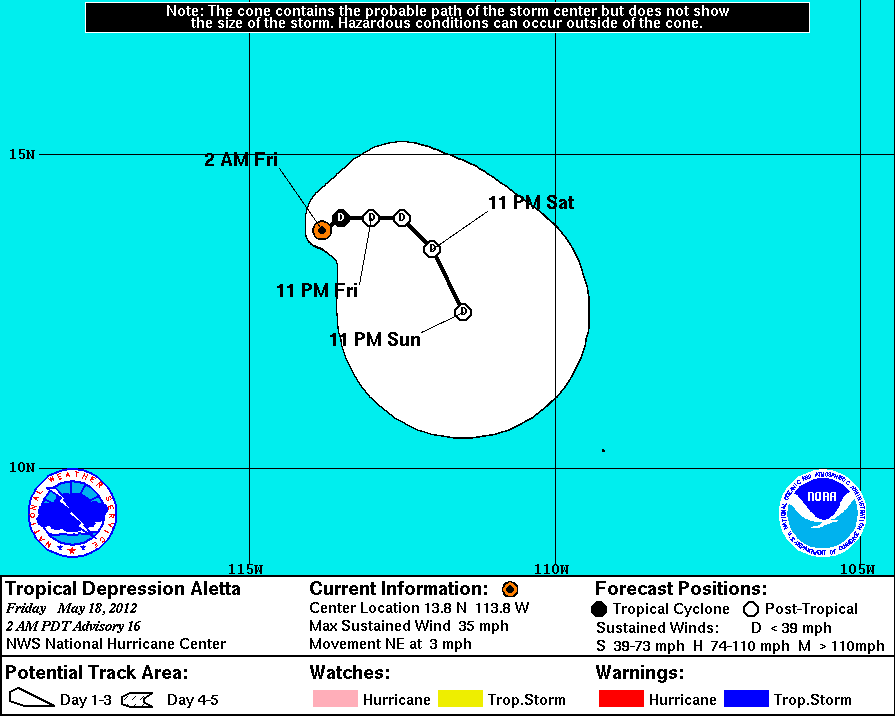
Tropical Storm Aletta
Hurricane Season in the Pacific doesn't officially start until May 15th, but there already is a named storm South of Manzanillo, Mexico.  Tropical Storm Aletta strengthened to a named storm just 12 hours after forming.
800 AM PDT SAT MAY 19 2012
 
...ALETTA BECOMES POST-TROPICAL...THIS IS THE LAST ADVISORY... 
  
SUMMARY OF 800 AM PDT...1500 UTC...INFORMATION
----------------------------------------------
LOCATION...14.8N 112.5W
ABOUT 585 MI...940 KM SSW OF THE SOUTHERN TIP OF BAJA CALIFORNIA
MAXIMUM SUSTAINED WINDS...30 MPH...45 KM/H
PRESENT MOVEMENT...ENE OR 65 DEGREES AT 5 MPH...7 KM/H
MINIMUM CENTRAL PRESSURE...1006 MB...29.71 INCHES

CRUISE SHIP IMPACT
None  
MAXIMUM SUSTAINED WINDS ARE NEAR 30 MPH...45 KM/H...WITH HIGHER
GUSTS.  THE POST-TROPICAL CYCLONE IS EXPECTED TO DISSIPATE IN A
COUPLE OF DAYS.


WATCHES AND WARNINGS

THERE ARE NO COASTAL WATCHES OR WARNINGS IN EFFECT.
THIS IS THE LAST PUBLIC ADVISORY ISSUED BY THE NATIONAL HURRICANE
CENTER ON ALETTA. FOR ADDITIONAL INFORMATION ON THE REMNANTS OF
ALETTA PLEASE SEE HIGH SEAS FORECASTS ISSUED BY THE NATIONAL
WEATHER SERVICE...UNDER AWIPS HEADER NFDHSFEPI AND WMO HEADER
FZPN01 KWBC.
 
Historical Data :  Graphics    Archive    
 
800 AM PDT MON MAY 14 2012
 
...FIRST TROPICAL DEPRESSION OF THE 2012 EASTERN NORTH PACIFIC
HURRICANE SEASON FORMS AHEAD OF THE OFFICIAL SEASON START DATE...
 
800 PM PDT MON MAY 14 2012
 
...DEPRESSION BECOMES FIRST TROPICAL STORM OF THE YEAR IN THE
EASTERN NORTH PACIFIC... 

Monday, August 15, 2011

Sixth Tropical Storm Forming in East Pacific

Tropical Storm Fernanda
MIDWAY BETWEEN THE SOUTHERN TIP OF BAJA
CALIFORNIA AND THE HAWAIIAN ISLANDS
 
1100 AM HST FRI AUG 19 2011

...FERNANDA WEAKENS TO A TROPICAL DEPRESSION... 
 
We are monitoring a new storm which has formed midway between the southern tip of Baja California and the Hawaiian Islands. Tropical Depression Six-E became the sixth named Tropical Storm on Tuesday.   The storm is on the weak side which leads forecasters to believe it may become a remnant within the five day cone.  There are no watches or warnings posted at this time.
  
East Pacific Graphical Tropical Weather Outlook
 
Not the storm you are looking for?  Click Image or Here

SUMMARY OF 1100 AM HST...2100 UTC...INFORMATION
-----------------------------------------------
LOCATION...14.6N 142.1W
ABOUT 950 MI...1525 KM ESE OF SOUTH POINT HAWAII
MAXIMUM SUSTAINED WINDS...65 MPH...100 KM/H
PRESENT MOVEMENT...WNW OR 300 DEGREES AT 14 MPH...22 KM/H
MINIMUM CENTRAL PRESSURE...994 MB...29.35 INCHES
  
MAXIMUM SUSTAINED WINDS ARE NEAR 65 MPH...100 KM/H...WITH HIGHER
GUSTS. SOME WEAKENING IS FORECAST DURING THE NEXT 48 HOURS.
 
Historical Data:             Archive        Graphics Archive     

This storm originated in the Eastern Pacific, with the first bulletins issued by NHC. Visit NHC's Archive for Fernanda to view their bulletins.
Bulletins issued by CPHC for Tropical Storm Fernanda (2011)

200 AM PDT THU AUG 18 2011
...FERNANDA MOVING TOWARD THE CENTRAL PACIFIC...
  
THIS IS THE LAST PUBLIC ADVISORY ISSUED BY THE NATIONAL HURRICANE CENTER ON FERNANDA. FUTURE ADVISORIES WILL BE ISSUED BY THE CENTRALPACIFIC HURRICANE CENTER
     

Tropical Storm Resources (click links below)
Tropical Storm Fernanda
East Pacific Tropical Weather Outlook National Weather Service
East Pacific Tropical Weather Discussion Hurricane Preparedness
Graphical Tropical Weather Outlook (EPAC) Real-Time Hurricane Information
Active Storms  NOAA Satellites & Information
NASA: Latest Storm Images WMO Severe Weather Information Centre
Real-time Monitoring (E. Pacific) The Saffir-Simpson Hurricane Wind Scale
Real-time Weather Sites Real-Time Cruise Ship Tracking