Showing posts with label legislation. Show all posts

Tuesday, May 25, 2021

Cruising Returning to Alaska

Cruising Return  to Alaska
click images to enlarge


2021 Alaska Season Open

The Alaska cruise season has a short window, usually from mid-May through September.  The cruise lines have been working closely with the CDC, Alaska, Canada, and government officials to try to salvage at least part of the 2021 Alaska Season.   We are happy to report that it will be possible to have a shortened season.   

While not all details are finalized, the cruise lines are beginning to announce their schedules and booking reservations.   It is anticipated that demand will exceed supply, so book early if this is something you are interested in doing.
PVSA legislature

What is PVSA

The Passenger Vessel Services Act of 1886 (sometimes abbreviated to PVSA) is a protectionist piece of United States legislation which came into force in 1886 relating to transport of goods or passengers between two places in the same country by a transport operator from another country.
No foreign vessels shall transport passengers between ports or places in the United States, either directly or by way of a foreign port, under a penalty of $200 (now $762) for each passenger so transported and landed.
The Passenger Vessel Services Act, however, 
  • does not prohibit foreign-flagged ships departing from and returning to the same U.S. port, provided the ship visits any foreign port; 
  • does not prohibit foreign-flagged ships departing from a U.S. port, visiting a distant foreign port, and then continuing to a second U.S. port. However, in order to embark in a U.S. port and disembark in a second U.S. port, the vessel must visit a distant foreign port outside of North America (Central America, Bermuda, the Bahamas, and all of the Caribbean except Aruba, Bonaire, and CuraƧao, count as part of North America).
 
Because of this legislation, cruise ships typically stop in a Canadian port when cruising in Alaska to avoid the fees per passenger. Since Canada has not opened their borders to cruise ships, the Alaska season was in jeopardy, even if CDC gave the green light to resume cruises from U.S. ports this summer.
Note:  some people call the PVSA the Jones Act -- but they are two different things. The Jones Act is a federal law that regulates maritime commerce in the United States. The Jones Act requires goods shipped between U.S. ports to be transported on ships that are built, owned, and operated by United States citizens or permanent residents.
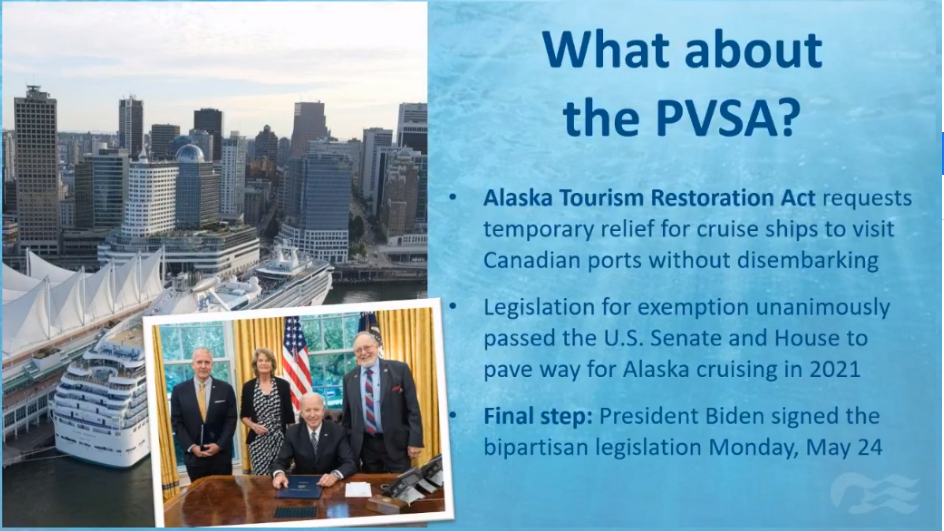
Alaska Tourism Restoration Act

Late last week, after ASTA Legislature Day on Capitol Hill in Washington D.C., both the Senate and House of Representatives passed legislation that would allow cruise ships to avoid stopping in a foreign port (somewhere in Canada) during the Alaskan cruise.   President Biden signed it into law on Monday.

Several cruise lines have posted their plans for inside passage cruises from Seattle, Washington.  These will be roundtrip seven day cruises.  Cruisetours will not occur on these voyages, however we work with suppliers that could provide a land tour.

We will post additional details about the cruises to Alaska, as well as additional destinations, in blog posts.   Be sure to follow us for the latest news.   Contact us to help plan your next vacation on land or sea.   Just like the Alaskans, we depend on tourism for our income, so we appreciate the opportunity to create new memories for you and your traveling companions.   We also have all the details regarding health and safety so you can plan with confidence.


Mini Series Industry News

Stay Updated on Recent 
Cruise Industry 
& Other Travel News

Click Image for Related Posts


I recently completed extensive training and have become Travel Safety Verified. As your dedicated Travel Advisor, your safety is our priority, and it's our job to ensure you have the necessary information you need to give you confidence and peace of mind when making your future travel plans. Click the link to review our Travel Safety program with valuable resources that will answer many of your questions.


Where have you explored? 

Gather your travel and food pics and join us every Wednesday night for the latest installment of #FoodTravelChat


Tuesday, May 11, 2021

Vaccination Role in Cruise Restart

Royal Vaccinations

 Crew & Passenger Vaccinations

In CDC's recent letter to the cruise lines, they outlined necessary procedures to resume sailing from U.S. ports of call.  One of the options has cruise lines and passengers scrambling, if they want to move up the timeline for the resumption of operations.

One of the conditions is for the cruise ship to sail with 98% of the crew vaccinated and 95% of the passengers also vaccinated.  What that would mean is all adults 18+ would be vaccinated and the 5% would consist of children who have yet to be allowed access to vaccines in most states.

Without meeting these conditions, the cruise line would need to perform test cruises and petition the CDC to grant them permission to sail after successfully completing those cruises.   The CDC would have 5 days to respond (down from 30 to 60 in original plans).

Vaccinating Crew

As you can imagine that it is no small task, to get tens of thousands of crew, who live all over the world, vaccinated to meet this requirement.   

Royal Caribbean International CEO Michael Bayley said "It is going to be extremely important that our crew are vaccinated," in an April 30 Facebook post. 

 He went on to say "We are working to help make this possible and have been assured vaccine availability will significantly improve in the coming weeks and months globally," Bayley wrote. "I encourage all crew to get vaccinated at home if possible and to be guided by their national health authority."

Ports Helping

PortMiami is among U.S. ports that have stepped up to help provide vaccinations to crew coming from ships docked in their port.   Navigator Captain Angel Oviol (pictured above) was among crew vaccinated this week in the PortMiami. 

Port Canaveral is another Florida port that is making arrangements, via cooperation among a local healthcare center, the fire department and cruise ship medical personnel, to provide up to 1,000 vaccines a day to crew members and shoreside and waterside support workers.

Florida Governor Sending Mixed Signals 

Governor Ron DeSantis appears to want cruising to resume out of Florida ports of call.  He sued the CDC and the Biden administration to get cruising started immediately. The suit asks the court to “set aside the CDC’s unlawful actions and hold that cruises should be allowed to operate with reasonable safety protocols.” 

“We don’t believe the federal government has the right to mothball a major industry for over a year based on very little evidence and very little data,” DeSantis said in a news conference at Miami’s seaport. He went on to say, “I think we have a good chance for success.” 

One of the safety protocols, at least for initial sailings, is to have fully vaccinated crew and passengers. Governor Ron DeSantis Signed Landmark Legislation, Senate Bill (SB) 2006, to ban vaccine passports and stem government overreach. The legislation codifies the prohibition of COVID-19 vaccine passports. Governor DeSantis enacted this prohibition through an executive order last month, blocking any business or government entity from requiring proof of COVID-19 vaccination.

On one hand he wants to get cruising started immediately, but it appears this legislation would block the cruise line for requiring proof of vaccination.  Without that proof they will be unable to satisfy the CDC requirement for speeding up the resumption of sailing.

There is more positive news regarding vaccines coming out of Florida legislations:

A Florida Public Health Advisory approved by Governor Ron DeSantis and the state's surgeon general and issued on April 29 that expands vaccine eligibility to include "individuals who are in the state for purpose of providing goods or services for the benefit of residents and visitors of the state of Florida."

PortMiami and Port Canaveral were therefore able to provide the vaccinations to the crew under this health advisory, which the governor approved.

All eyes are on the Florida State Capital to see how these actions play out and help or hinder the resumption of cruising out of Florida.  The lines have stated that they will move more ships if this isn't sorted out soon.  Florida stands to lose more jobs and millions of dollars in revenue if the cruising pause continues.  Hopefully this won't require the courts to get further involved; doing so would only further delay things.

We continue to monitor all our travel providers current plans and requirements for travel which they plan to implement.  Follow us on any of our social media platforms to stay informed.


Stay Updated on Recent 
Cruise Industry 
& Other Travel News

Click Image for Related Posts


I recently completed extensive training and have become Travel Safety Verified. As your dedicated Travel Advisor, your safety is our priority, and it's our job to ensure you have the necessary information you need to give you confidence and peace of mind when making your future travel plans. Click the link to review our Travel Safety program with valuable resources that will answer many of your questions.


Where have you explored? 

Gather your travel and food pics and join us every Wednesday night for the latest installment of #FoodTravelChat


Friday, July 20, 2012

Future of Cruise Ships in Venice

Will Cruise Ships Be Banned From Venice?

Earlier this year we wrote about the concerns raised by UNESCO about cruise ships impact on the World Heritage Site of Venice.  Following the Costa Concordia disaster, the organization called on the Italian government to impose restrictions on large cruise ships in Venice.   See Concordia Disaster Rekindles Venice Restrictions for details.

The picture above was taken by us during a recent Mediterranean voyage which ended in Venice.  You can see the balcony railing on the left which gives a perspective of how close the ship passed the heart of Venice.   We were just about to pass St. Mark's Square as this image was captured.

 UNESCO REPORT

The state of the lagoon is a deep cause of concern. "The wash churned up by the ships is hollowing out the seabed and gradually turning the lagoon into an inlet of the Adriatic," warns Angelo Marzollo, the author of a UNESCO report. "The erosion is particularly bad in the southern part." 

NEW LEGISLATION

Earlier this week, news surfaced about a law that was under review by the Italian Parliament which would give the city council powers over the city and surrounding waters.  This bill, under review of an environmental committee, was developed to safeguard Venice and the lagoon. 

Those in support of the legislation would call for ships over 30,000 tons to be required to moor outside the lagoon.  Unfortunately, there currently isn't an alternative solution to docking at the cruise terminal at the end of the Grand Canal, so nothing has been changed to date.

FLASHMOB SHOWS SUPPORT

More than 600 people -- porters, mooring, security, hospitality and tourism operators gathered at the Venice passenger terminal to support the cruise industry.  Venice relies heavily on tourism and the supporters rallied to call attention to the more than 3,000 jobs made possible by the cruise ship industry.

There are those that say cruise passengers spend little money in Venice during their stays, so they question the value of the passengers to their economy.  

One thing is for certain, something needs to be done to protect Venice for generations to come and also safeguard the workers whose livelihood depends on tourism.   We will continue to watch this story as it develops.

Meanwhile we suggest you plan a cruise to Venice as soon as you can before changes are made that prevent you from having the experience of sailing into Venice.   It is an experience that you will cherish for the rest of your life.   Seeing the canals from the ship is truly a unique perspective.

For more information on our Mediterranean adventure see:

Saturday, June 12, 2010

U.S. Senate Passes Cruise Ship Safety Legislation

Legislation to Enhance Cruise Ship Safety

As discussed in previous blog post  Keeping Cruise Ship Passengers Safe, there are several safety measures in place today which were implemented by the cruise industry.   Legislators have been reviewing the existing measures and believe there is room for improvement.

The U.S. Senate has unanimously passed legislation by Senator John Kerry (D-Mass.) to increase security, law enforcement, and accountability on cruise ships in international waters.

Sen. Kerry is a senior member of the Senate Commerce Committee, which unanimously approved the Cruise Vessel Security and Safety Act in July 2009.  Rep. Doris Matsui (D-Calif.) is the sponsor of companion legislation, H.R. 3360, which has already been passed in the U.S. House of Representatives.

The Cruise Vessel Security and Safety Act will:
  • improve ship safety by requiring forty-two inch guard rails, peep holes in every passenger and crew member’s door, on-deck video surveillance, and an emergency sound system;
  • provide transparency in reporting by establishing a structure between the cruise industry, the FBI, and the Coast Guard, including requirements that each ship maintain a log book, which would record all deaths, missing individuals, alleged crimes, and passenger/crewmember complaints regarding theft, sexual harassment, and assault;
  • improve crime scene response by requiring rape kits, anti-retroviral medications, and a trained forensic sexual assault specialist be aboard each ship; and
  • establish a program designed by the Secretary of Transportation in consultation with the FBI to train appropriate crew members in crime prevention, detection, evidence preservation, and reporting of criminal activities in the international maritime environment. 
Senator Kerry commented on the legislation:

“The term ‘duty free’ does not apply to the safety of passengers." He continued “Murky lines of jurisdiction are no longer an excuse for risking the safety of millions of Americans who will board cruise ships this year. I applaud my colleagues for helping to ensure that security, safety, and accountability be strengthened to hold criminals accountable and end the cycle of serious crimes on these vessels.”

Cruise Lines International Association (CLIA) supports the legislation

“This legislation brings greater consistency and clarification to many industry practices and existing regulations, including a longstanding federal requirement to report to the FBI allegations of serious crimes occurring in U.S. waters or involving a U.S. national anywhere in the world. The legislation also establishes additional safety provisions,” CLIA said. 

“The safety and security of our guests and crew is CLIA's number one priority. The cruise industry has reported allegations of serious crimes to federal law enforcement agencies for many years and looks forward to continuing our longstanding work with the U.S. Coast Guard, FBI, and law enforcement both here and elsewhere around the world. The cruise industry has comprehensive policies and procedures that ensure guests are safe and secure while enjoying a cruise vacation. In fact, serious crime on cruise ships is rare, with millions of guests each year enjoying a safe cruise vacation.”

For more information, visit www.cruising.org or www.cruiseIndustryfacts.com.