Showing posts with label categories. Show all posts

Wednesday, January 27, 2016

Navigating 5 Types of Signs Onboard Cruise Ship

Signs Signs Everywhere a Sign

For Cruise Rookies:
If you've never been on a cruise, the following information about signs you'll see onboard your ship may come in handy.

For Cruise Veterans:

You may not have even noticed some of these signs the last time you were on a ship.  Perhaps you should pay more attention to the signs  the next time you are on a cruise.

For Every Cruiser:

Please pay attention to the Safety signs - they are there to protect you and make sure everyone enjoys their cruise.

In this article we'll feature signs that we photographed on Carnival Conquest.  You'll find similar signs on the other cruise lines as well.  Knowing about the types of signs onboard will help you make the most of your cruise vacation.

Safety Signs

The sign above is posted on your stateroom door.  It contains the layout of your deck, marks your location, and emergency exits.  It also contains information about what to do in an emergency including how to put on your life jacket.   This is important reading, especially for first-time cruisers.

This next group of signs have important safety and conservation information.  It is everyone's responsibility to help prevent illness by washing their hands.  Everyone on board the ship needs to work together for the comfort and safety of others and to preserve the environment for the future.


Click for Larger Images
  
Directional Signs 

Here are just a few examples of signs that help you find your way on the ship.  In this modern age there are now electronic signs that provide current information and directions.  Public rooms have a sign on the door similar to this one (note it even has braille lettering).  Lastly, you'll see signs like the one in the middle that direct you to popular locations on the ship.


Food & Beverage Signs 

These signs come in several types.  The first one lists the hours of operation of a very popular bar on Carnival cruise ships.  The second sign instructs you on how to order your custom-made burrito.  Finally there are signs describing drink packages which can be purchased on your first day on the ship, which could possibly save you money over the length of the cruise (depending on how much you'd normally order).  For more information on drink packages, see our previous article Bottomless Bubbles & Cheers.


Activity Signs 

There is a lot happening on the ship each day.   Cruise lines may also use signage to advertise popular events so that you don't miss them.   Here we learn about some casino special events and shore excursions.


Informational Signs 

The remaining signs we'll put in this category.   Typically they tell about special offers, which may be time limited.  Pictured are a sign explaining discounts in the shops, another one suggesting you capture a special image as a souvenir, and lastly how to earn bonus points on the money spent on your cruise.


This Friday on Twitter 

@ChrisPappinMCC is a weekly photo forum run by et al. We helped co-host a few times but have turned the reins back over to Alex and team. 

Theme suggestions are solicited for each week.   If you can't guess, this week's theme is #SIGNS so we thought we'd get a head start with this selection.   Be sure to join us on Friday.

Follow us on Twitter: @ChrisPappinMCC  Pinterest: CruiseWithChris Pappin and Facebook: CruiseWithChris Pappin Cruises Inc for more ideas.

Wednesday, July 16, 2014

Navigating 5 Types of Signs Onboard Cruise Ship

Signs Signs Everywhere a Sign

For Cruise Rookies:
If you've never been on a cruise, the following information about signs you'll see onboard your ship may come in handy.

For Cruise Veterans:

You may not have even noticed some of these signs the last time you were on a ship.  Perhaps you should pay more attention to the signs  the next time you are on a cruise.

For Every Cruiser:

Please pay attention to the Safety signs - they are there to protect you and make sure everyone enjoys their cruise.

In this article we'll feature signs that we photographed on Carnival Conquest.  You'll find similar signs on the other cruise lines as well.  Knowing about the types of signs onboard will help you make the most of your cruise vacation.

Safety Signs

The sign above is posted on your stateroom door.  It contains the layout of your deck, marks your location, and emergency exits.  It also contains information about what to do in an emergency including how to put on your life jacket.   This is important reading, especially for first-time cruisers.

This next group of signs have important safety and conservation information.  It is everyone's responsibility to help prevent illness by washing their hands.  Everyone on board the ship needs to work together for the comfort and safety of others and to preserve the environment for the future.


Click for Larger Images
  
Directional Signs 

Here are just a few examples of signs that help you find your way on the ship.  In this modern age there are now electronic signs that provide current information and directions.  Public rooms have a sign on the door similar to this one (note it even has braille lettering).  Lastly, you'll see signs like the one in the middle that direct you to popular locations on the ship.


Food & Beverage Signs 

These signs come in several types.  The first one lists the hours of operation of a very popular bar on Carnival cruise ships.  The second sign instructs you on how to order your custom-made burrito.  Finally there are signs describing drink packages which can be purchased on your first day on the ship, which could possibly save you money over the length of the cruise (depending on how much you'd normally order).  For more information on drink packages, see our previous article Bottomless Bubbles & Cheers.


Activity Signs 

There is a lot happening on the ship each day.   Cruise lines may also use signage to advertise popular events so that you don't miss them.   Here we learn about some casino special events and shore excursions.


Informational Signs 

The remaining signs we'll put in this category.   Typically they tell about special offers, which may be time limited.  Pictured are a sign explaining discounts in the shops, another one suggesting you capture a special image as a souvenir, and lastly how to earn bonus points on the money spent on your cruise.


This Friday on Twitter 

@ChrisPappinMCC is a weekly photo forum by . Theme is revealed every Tues 12pm ET.  If you can't guess, this week's theme is #SIGNS so we thought we'd get a head start with this selection.   Be sure to join us on Friday.

Follow us on Twitter: @ChrisPappinMCC  Pinterest: CruiseWithChris Pappin and Facebook: CruiseWithChris Pappin Cruises Inc for more ideas.

Sunday, May 26, 2013

Hurricane Preparedness 2013 - Basics & History


Hurricane Basics & History
First In the 2013 Series
Hurricane Preparedness Week playlist on YouTube


Looking for past or current hurricanes?  Click Image or Here
President Obama declared May 26 - June 1 “National Hurricane Preparedness Week." FEMA, along with the National Oceanic and Atmospheric Administration (NOAA), is helping to raise awareness of steps that can be taken to help protect citizens, and their communities and property. 

What is a Hurricane?
A hurricane is a type of tropical cyclone, which is a generic term for a low pressure system that generally forms in the tropics. The cyclone is accompanied by thunderstorms and, in the Northern Hemisphere, a counterclockwise circulation of winds near the earth's surface. Tropical cyclones are classified as follows:

* Sustained winds
A 1-minute average wind measured at about 33 ft (10 meters) above the surface.

** 1 knot = 1 nautical mile per hour or 1.15 statute miles per hour. Abbreviated as "kt".
Tropical Depression
An organized system of clouds and thunderstorms with a defined surface circulation and maximum sustained winds* of 38 mph (33 kt**) or less

Tropical Storm
An organized system of strong thunderstorms with a defined surface circulation and maximum sustained winds of 39-73 mph (34-63 kt)

Hurricane
An intense tropical weather system of strong thunderstorms with a well-defined surface circulation and maximum sustained winds of 74 mph (64 kt) or higher

Familiarize yourself with the terms that are used to identify a hurricane.
  • A hurricane watch means a hurricane is possible in your area. Be prepared to evacuate. Monitor local radio and television news outlets or listen to NOAA Weather Radio for the latest developments.
  • A hurricane warning is when a hurricane is expected in your area. If local authorities advise you to evacuate, leave immediately.
Hurricanes are classified into five categories based on their wind speed, central pressure, and damage potential. Category Three and higher hurricanes are considered major hurricanes, though Categories One and Two are still extremely dangerous and warrant your full attention.The following chart details the categories and the damage that can result from a storm with that strength.
 
Saffir-Simpson Hurricane Scale
2012 Revision to the Saffir Simpson Hurricane Wind Scale (PDF)

Scale Number (Category) Sustained  Winds Damage Storm Surge


1
74-95 mph
64-82 kt
119-153 km/h
Very dangerous winds will produce some damage: Well-constructed frame homes could have damage to roof, shingles, vinyl siding and gutters. Large branches of trees will snap and shallowly rooted trees may be toppled. Extensive damage to power lines and poles likely will result in power outages that could last a few to several days. 4-5 feet


2
96-110 mph
83-95 kt
154-177 km/h
Extremely dangerous winds will cause extensive damage: Well-constructed frame homes could sustain major roof and siding damage. Many shallowly rooted trees will be snapped or uprooted and block numerous roads. Near-total power loss is expected with outages that could last from several days to weeks. 6-8 feet


(major)
111-129 mph
96-112 kt
178-208 km/h
Devastating damage will occur: Well-built framed homes may incur major damage or removal of roof decking and gable ends. Many trees will be snapped or uprooted, blocking numerous roads. Electricity and water will be unavailable for several days to weeks after the storm passes. 9-12 feet


4
(major)
130-156 mph
113-136 kt
209-251 km/h
Catastrophic damage will occur: Well-built framed homes can sustain severe damage with loss of most of the roof structure and/or some exterior walls. Most trees will be snapped or uprooted and power poles downed. Fallen trees and power poles will isolate residential areas. Power outages will last weeks to possibly months. Most of the area will be uninhabitable for weeks or months. 13-18 feet


(major)
157 mph or higher
137 kt or higher
252 km/h or higher
Catastrophic damage will occur: A high percentage of framed homes will be destroyed, with total roof failure and wall collapse. Fallen trees and power poles will isolate residential areas. Power outages will last for weeks to possibly months. Most of the area will be uninhabitable for weeks or months. Greater than 18 feet

Hurricane History


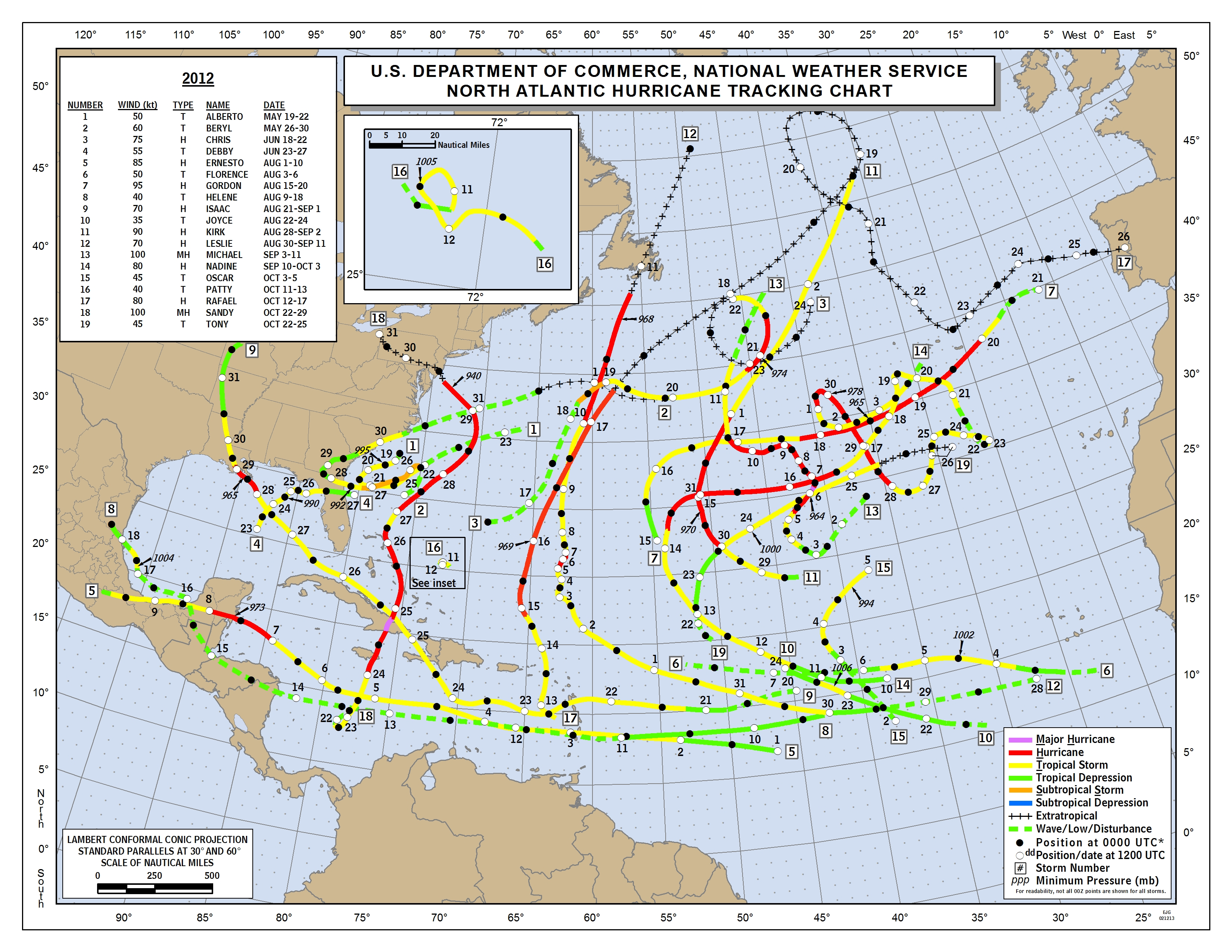
  2012 Atlantic Hurricane Season Track Map
2012 Atlantic Hurricane Season Track Map (click to enlarge)


In the following article, we look at the 2012 Hurricane season in review, comparing the forecast to actual results.   We also look at NOAA and Colorado State University forecasts for the 2013 Season.

Hurricane Service Assessments
Billion Dollar Storms
Other events since 1980


(Compiled by the Central Pacific Hurricane Center, Honolulu).

We will continue coverage of Hurricane Preparedness Week by looking at some of the hazards starting tomorrow.  Additional Hurricane information can be found in our static Weather tab.