Showing posts with label fuel. Show all posts

Thursday, April 22, 2021

LNG Powers the Fun

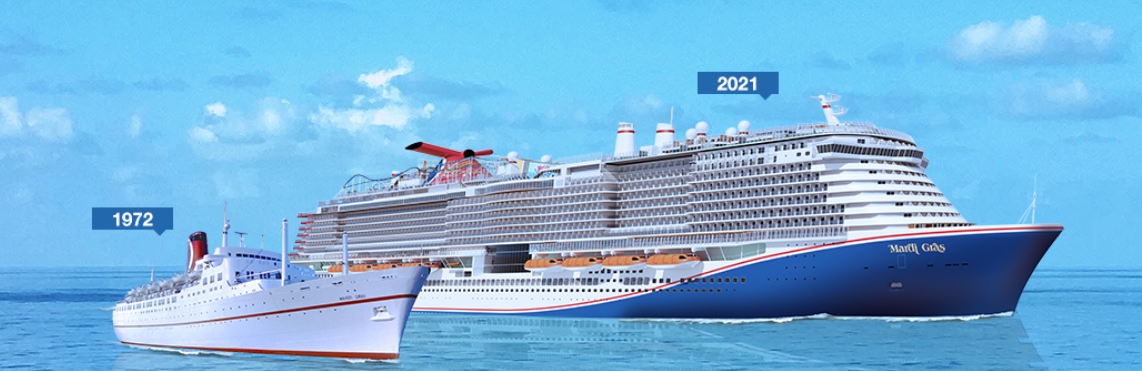
Mardi Gras Then & Now

Mardi Gras - You've Come a Long Way Baby


On this Earth Day 2021, Carnival Corporation released a video explaining how Liquefied Natural Gas (LNG) will play a role in helping them meet their sustainability goals. 

Carnival Mardi Gras will be the first LNG-powered cruise ship to home port in North America. Mardi Gras, which was to have debuted last year but due to the COVID-19 shutdown, her debut is still to come. Sister ship Carnival Celebration is set to debut out of PortMiami in 2022. 

Mardi Gras, the first of Carnival's Excel class ships, required a new terminal. Port Canaveral rebuilt Cruise Terminal 3 to support what is the largest ship in Carnival’s fleet, coming in at 1,130 feet long, 180,800 gross tons and a 5,282-passenger capacity based on double occupancy. 

 LNG creates less exhaust than commonly used cruise industry fuel. It’s an odorless, colorless fuel in its liquid state kept cold at -259 degrees Fahrenheit. The fuel will be stored in three tanks onboard the ship. While the ship will be refueled weekly, the design allows for 14 days of cruising without refueling. The fuel will power the propulsion system as well as everything else onboard the ship. 

 To operate this LNG powered ship introduces new logistic issues which Carnival has planned for. LNG isn't readily available in all ports of call. A special refueling barge will be used in Port Orlando to refuel the vessel in order to comply with necessary safety protocols. Port Canaveral also invested in additional fire training for their personnel and a new fire boat, to address safety concerns with LNG use. 

Watch this video to learn more about LNG fuel and Carnival's commitment to sustainability. You can also visit carnivalsustainability.com to learn more about their environmental goals and progress to date.

 “The introduction of new, more efficient ships, and investments in other technologies and initiatives, we intend to continue to build on our pledge and continue to reduce emissions and exceed our goals,” the video states.


View Mardi Gras Itineraries


I recently completed extensive training and have become Travel Safety Verified. As your dedicated Travel Advisor, your safety is our priority, and it's our job to ensure you have the necessary information you need to give you confidence and peace of mind when making your future travel plans. Click the link to review our Travel Safety program with valuable resources that will answer many of your questions.


Where have you explored? 

Gather your travel and food pics and join us every Wednesday night for the latest installment of #FoodTravelChat

Monday, July 1, 2013

Emissions Regulations Prompt Deployment Changes

North American Emission Control Area     Source: EPA
New Rules Impact Cruise Industry

We are eighteen months away from the implementation of new regulations restricting the Sulfur oxide (SOx) emissions of marine fuel in the North American Emission Control Area (ECA).   Under the new regulations, effective January 1, 2015, cruise ships operating in the zone must only emit .01% instead of the currently allowed 1% levels.  The ECA requirements will become enforceable in the U.S. Caribbean ECA in January 2014.

Complete details can be found in this EPA Briefing.

These low-sulfur fuel requirements could dramatically increase operating costs for the cruise lines and Carnival Cruise Lines has announced deployment changes of several ships as it tries to get ahead of the curve of the new regulations.

Where is the North American ECA 

The area of the North American ECA includes waters adjacent to the Pacific coast, the Atlantic/Gulf coast and the eight main Hawaiian Islands. It extends up to 200 nautical miles from coasts of the United States, Canada and the French territories, except that it does not extend into marine areas subject to the sovereignty or jurisdiction of other States.


Carnival Cruise Lines Deployment Changes

The announced redeployments means reduced Atlantic Canada cruises and no ships homeporting out of Baltimore, Boston or Norfolk, Virginia.These are the first announced changes that site the North American ECA and associated fuel costs as the determining factor.

Carnival Cruise Lines and others, including Royal Caribbean, which has ships in the same ports, are working closely with the EPA to find alternative means to reduce the emissions. One possibility is scrubber technology as cited in the letter in the references below.

Ship / Effective Date Deployment Changes
Carnival Pride
December, 2014
Repositions from Baltimore to Tampa
Carnival Glory
November, 2013
 Sailed seasonally from Boston or Norfolk; Repositions to Miami

The cruise lines have held the line on passing fuel surcharges along to consumers. Hopefully they will be able to find an economical solution to protecting the environment.

April 2013 CLIA Position on North American ECA

The Cruise Line International Association (CLIA) made the following statement earlier this year:

"CLIA supports the goals and principles of the North American Emission Control Area (ECA). Our industry is committed to protecting coastal air quality not only because it is the responsible thing to do, but also because the very nature of our business depends on a healthy natural environment. We are proud of the environmental stewardship of our member lines and their proactive response to applicable international and Federal air emissions requirements wherever their ships operate."  

They, along with the IMO, have proposed the following:

"The industry supports a variety of flexible approaches that can be utilized to achieve equal or better health benefits, including averaging based on air quality, innovative exhaust scrubbers, using alternative energy sources such as shore power in port, and adjusting ship speeds."  [Full article]


Additional References:

EPA’s Office of Transportation and Air Quality web site

Designation of Emission Control Area to Reduce Emissions from Ships in the U.S. Caribbean

Designation of North American Emission Control Area to Reduce Emissions from Ships (PDF)

Letter to IMO from EPA and U.S Coast Guard regarding equivalent methods to comply with the ECA fuel sulfur requirements (PDF)

We will continue to monitor this developing story.   It is unfortunate that Carnival Cruise Lines has made these changes, but hopefully they will be able to return to these homeports in the future.

Tuesday, February 19, 2013

Triumph Fire Investigation

Photo courtesy U.S. Coast Guard
Carnival Triumph
Fire Investigtion
Launched

Coast Guard investigators from the Coast Guard Marine Safety Center and the Investigations Center of Expertise examine the cruise ship Carnival Triumph's engine room, Feb. 14, 2013, to determine the cause of a fire that broke out Feb. 10 and stranded the ship with its passengers for days in the Gulf of Mexico. The results of the joint international investigation may take months, but could possibly help prevent the same type of incident from happening in the future. (U.S. Coast Guard photo by Lt. Jerry Federer)

The U.S. Coast Guard and the National Transportation Safety Board launched an investigation into the circumstances surrounding a fire aboard the Carnival Triumph, that ocurred Sunday, February 10, 2013. Because the Carnival Triumph is a Bahamian flagged vessel, the Bahamas Maritime Authority is the primary investigative agency. In accordance with international guidelines, the U.S. will participate in this investigation as a Marine Safety Investigative State.

Preliminary Results 

In a statement released to the media on Monday by the U.S. Coast Guard, the fire on the Carnival Triumph cruise ship was caused by a leak in a fuel oil return line. The complete investigation will last approximately six months according to the USCG.

The leak appears to have been in an oil return line that stretches from the ship's No. 6 engine to the fuel tank. Based on the ignition marks on the wall, the fire broke out in front of one of three generators in the engine room. It will take at least a week before determining if this was the same generator that had mechanical issues in January.

Legal Proceedings

As the investigation continues, so too begins legal proceedings that seem to follow incidents like this. To date there have been two lawsuits filed by passengers on the Carnival Triumph. We will follow both of these developing stories and update you periodically as information is released to the public.

Tuesday, January 24, 2012

Costa Concordia Fuel Removal

Video Links:
Click for a video explanation
Preparations Underway to Salvage Fuel from Costa Concordia

Upon becoming aware of the evacuation of Costa Concordia, SMIT approached the owners and underwriters of the Costa Concordia bidding  for the salvage contract.
SMIT has an extensive track record relating to marine emergency response, refloating stranded vessels and wreck removals. In the days following the accident, a contract was awarded by the Owners to SMIT and local partners Tito Neri for the removal of the bunker oil and pollution control.  

The estimated amount of bunkers in the vessel is 2200 MT of IFO (intermediate fuel oil), 185 MT of MGO (marine gas oil/diesel) and lubricants, distributed over 17 tanks.  We have seen conflicting reports of the amount of fuel.  The latest number we have seen involves 13 double-bottomed tanks and 10 single-bottom tanks.  

In the days following the accident, a contract was awarded by the Owners to SMIT and local partners Tito Neri for the removal of the bunker oil and pollution control.

24 January - Preparation Begins
Following a press conference held by the authorities yesterday on the island of Giglio, which was also attended by representatives of Costa Cruises and SMIT Salvage, it was stated that SMIT Salvage would be allowed to commence with the preparations for the oil removal today.  The work will be done in tandem with the search and rescue efforts.   Click for Continuing Coverage (below)

The Process
  • SMIT Salvage placed its work/crane barge Meloria, pictured above, alongside the Costa Concordia.
  • Divers from SMIT Salvage will then inspect parts of the underwater ship and make the necessary preparations to remove the fuel from the ship. 
  • Next stage will be the drilling of holes in the fuel tanks and the installation of valves by means of a hot tap. 
While the fuel has been submerged, it has become solidified.  A hot tap is used to heat the fuel back into a liquid state so that it can be extracted.  This process will take several weeks with current estimates at 4 to 6 weeks.

Precautionary Measures
  • Double containment booms around the ship ( to concentrate oil in thicker surface layers so that skimmers, vacuums, or other collection methods can be used more effectively)
  • SMIT has mobilized an oil tanker with emergency response equipment including sweeping arms, booms and a skimmer.   (to respond to any spill that might occur)


Ongoing Updates

Overall updates of the Costa Concordia search and rescue operations are being made on the following blog post:   Costa Concordia Listing after Deadly Accident

This post will provide updates on the fuel salvage operations.


24 March - Removal Completed

This morning at 08.00 CET SMIT Salvage successfully completed its assignment on the removal of fuel from the Costa Concordia. Over the last couple of days, the SMIT Salvage diving team transferring HFO from the last settling tank in the engine room. Early this morning, the last tanks were completed, closed and sealed off.

The entire oil removal process which lasted just over one month went smoothly and was executed in line with expectations. Most of the diving and pumping equipment will be demobilized and brought back to Livorno onboard of the crane/work barge Meloria.

SMIT will retain a  small diving team and a diving foreman on the island under a so-called ‘caretaker contract'. The SMIT Salvage team will remain standby on the island for designated emergency duties until a contractor is appointed for the removal of the entire ship.

23 March - Oil Removed

2,400 tons of oil have been removed from the ship.  This process took five weeks to complete.   The ship still must be monitored for leaks and further cleanup efforts are pending, including the ultimate removal of the ship.   Six companies have submitted bids to Costa Cruises for the removal.

2 March - Double Bottom Tanks Completed

This afternoon the salvage team completed the discharge of Heavy Fuel Oil, Diesel Oil and Sludge from the Double Bottom Tanks. Weather permitting the crane barge Meloria will now be moved forward in her moorings in between the stabilizer and the large damaged area. An access hole will be created in the hull to allow the divers to enter the engine room spaces where the settling and service tanks are located.

Once the connections have been installed, the contents will be transferred to the offloading tanker. Thereafter the contents of the sewage tanks will also be pumped out of the ship.

23 February - Removal Progressing Well, Steady Pace

Salvage workers have extracted 1,300 cubic metres of fuel from six tanks, equivalent to two-thirds of the total on board.  Oil has been removed from all six forward tanks and the hoses, pumps and valves have been disconnected with the flanges sealed off. Following the successful oil removal from the forward ship, the crane barge was disconnected and brought back into the sheltered port on Monday morning. The fuel tanker 'Elba' into which the fuel was pumped has moved away from the Costa Concordia and a second fuel barge 'Magic Duba' is standby to replace the 'Elba'.

Since Monday, the wind and wave conditions have hampered the continuation of the oil removal process. As soon as the weather permits, the crane barge will be repositioned alongside the Costa Concordia. Based on the current planning, the mid-ship tanks containing MGO and two double bottom sludge tanks will have the next priority. These tanks will also be emptied using the hot tap method. Due to the unpredictable weather conditions, SMIT cannot provide an estimated date of completion.


13 February - Pumping Began Sunday

Yesterday afternoon, at 16.55, the first oil was removed from the Costa Concordia. In line with the presentation made on the January 28, the initial operation is focused on the forward fuel tanks. Currently four of the six forward fuel tanks have now been installed with a sealable flange. As operations continue, the remaining tanks will also be prepared.

The first tank which was connected to the pumps is relatively small and located on the port side of the Costa Concordia. The weather forecast for the coming days looks good and pumping will continue around the clock as long as the favorable conditions continue.

12 February - Removal Begins

Underwater pumping operations began Sunday to remove some of the 500,000 gallons of fuel aboard the Costa Concordia, after nearly two weeks of delays because of rough seas and bad weather. The removal operations will run 24 hours a day. The forecast for the next several days is favorable, so it is the hope of SMIT, who is running the operation, that the majority of the fuel in the forward tanks can be drained by week's end.This would represent about 60% of the fuel.

It will take approximately 28 consecutive days of pumping to empty the tanks.

28 January - Hot Tap Animation 


At a press conference held today on the island of Giglio, SMIT Salvage and its partner Fratelli Neri provided a technical briefing on the oil removal operation.  See Oil Removal Briefing - Click Here for Details

Two of the six forward fuel tanks have now been installed with a sealed flange and the remaining tanks were due to be prepared today. The six forward tanks are estimated to hold approximately two thirds of the (intermediate) fuel oil in the casualty.

Unfavorable weather once again played a role and the crane barge was disconnected from the casualty and brought into the protective port of the island Giglio.

25 January - Preparation Continues 


Divers from SMIT Salvage together with its partner Fratelli Neri have made significant progress:
  • Inspected forward section of the submerged underwater part of the ship
  • Marked the drilling locations of the heavy fuel oil tanks
  • Installed second inner protection barrier (oil booms)
Installation of hot tap valves on the outer hull of the vessel and drilling of holes through the hull into the oil tanks must be done before pumping of the oil can commence.